
How to Improve Feed Pellet Quality and Durability
Fines turn a full production run into rework and complaints from customers. Feed pellet quality depends on how formulation, conditioning, and the die work together, and process changes alone often cannot hold a hard-to-pellet formula together.
Learn how to measure durability and what weakens pellets, then see where Uniscope binders and lubricants close the gap. Uniscope has backed feed mills with hands-on technical support since 1975, and it’s time for you to experience that quality firsthand.
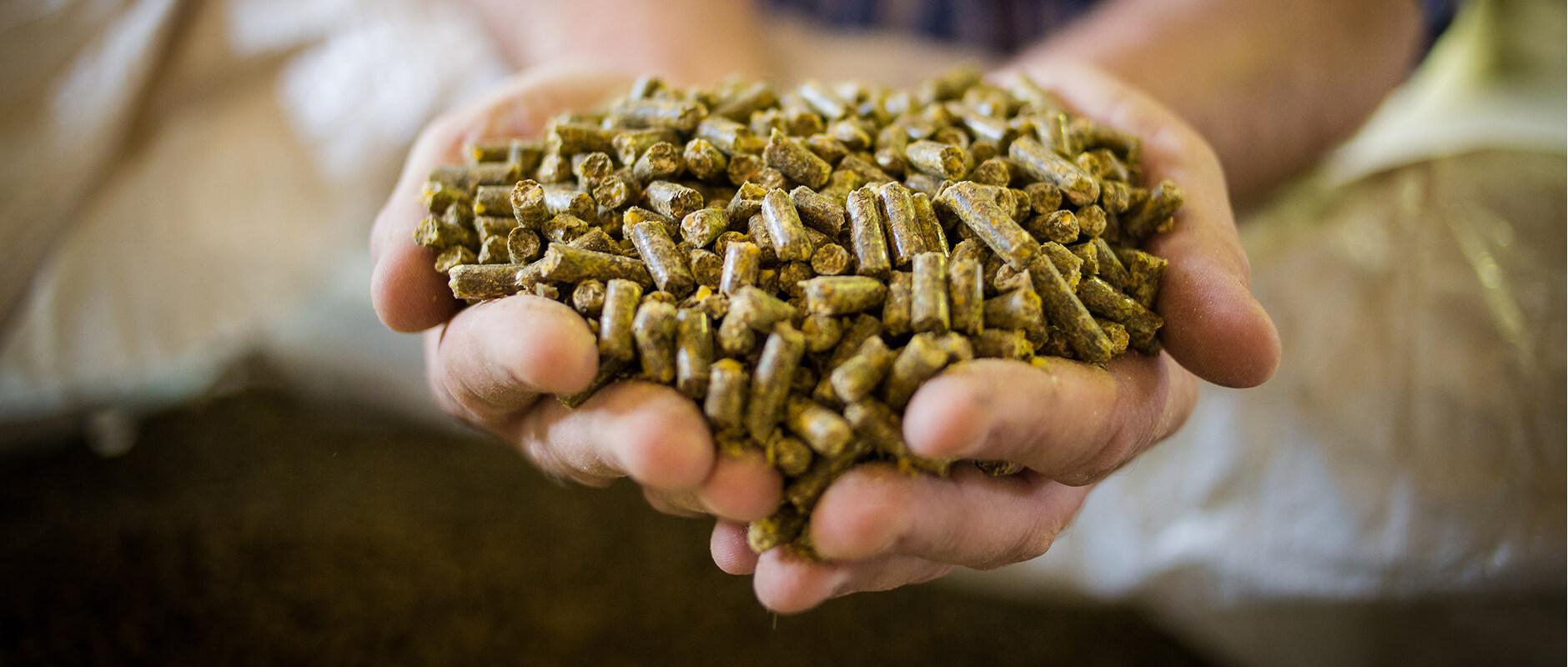
What Great Pellet Quality Looks Like When the Bag Opens
Pellet quality comes down to three traits: durability, hardness, and fines. Durable pellets survive each transfer between the cooler and the customer. Hard pellets hold their shape under the weight of a full load.
Fines are the scorecard, since every pound that turns to dust is feed your mill made and your customer cannot use. Uniscope feed binders strengthen the bond between particles, so pellets stay whole all the way to the feeder.
The PDI Test Shows How Your Pellets Hold Up Before Your Customers Find Out
The pellet durability index (PDI) puts a number on how well pellets survive rough handling. The PDI test speeds a real-world pellet lifecycle by tumbling a sample and weighing what stays whole.
Uniscope’s technical support team runs the Kansas State tumbling can method, one of the most common tumble tests, in four steps:
- Screen a fresh sample to remove existing fines.
- Weigh the intact pellets.
- Tumble them in the can for a set time.
- Screen again and weigh what remains.
Divide the final weight by the starting weight, and you have your PDI, the percentage of pellets that survived. Track it on every formula, because a dropping score exposes pellet fines before your customer’s feeder does.
Where Pellet Quality Slips Away Between the Grinder and the Bagger
Poor pellet quality rarely traces back to a single mistake. It builds at every stage of production, so check these five spots first:
- Formulation: Formulas high in fat, fiber, or urea resist binding, and the pellets crumble under light handling.
- Particle Size: A coarse or uneven grind leaves weak points where pellets crack, and durability swings from batch to batch.
- Conditioning: Too little heat or moisture keeps particles from bonding, which shows up as soft pellets and extra fines downstream.
- Die Specs: A worn die or the wrong compression for the formula produces uneven pellets and slows output.
- Cooling and Handling: Too little cooling time leaves moisture inside, and rough transfers snap pellets before they reach the bag.

How to Improve Pellet Quality and Cut Fines Before You Reach for Additives
Improve pellet quality with process changes first, because those levers already sit in your hands.
Adjust one variable at a time, such as steam, feed rate, or retention time, and log the PDI and fines after each change to see what actually worked.
Slower throughput often firms up pellets, but it costs output, and that cost tells you when to stop. Once adjustments start costing more in production than they recover, additives finish the job. That is the moment to call a Uniscope specialist, who can match the right additive to your formula.
Where a Feed Binder or Lubricant Finishes the Job
Every Uniscope product solves a specific problem, so the right pick depends on what your formula needs. Compare the full animal feed binder line to see how they fit together.
Super-Bind is a lignin sulfonate binder that works in any feed type. It handles high-grain rations and feeds with distillers’ grains, and it replaces high-inclusion lignin binders at a lower use rate.
Pel-Aid is a low-inclusion gelatin binder that also lubricates. It adds adhesion and durability to pet food and specialty feeds.
Starch Binder is a natural, modified starch that works at a low inclusion rate. Mills use it in high-fat formulas and aquafeeds.
Super-Lube is a pellet lubricant for hard-to-pellet feeds, such as swine starters and high-fiber or high-urea rations. It moves material through the die faster, so you can raise production rates.
Put a Uniscope Specialist on Your Mill Floor
Uniscope specialists walk the line with your team before they recommend a single product.
A third-party feed mill evaluation covers the entire facility, the process that turns raw ingredients into finished feed, and your quality control procedures. A detailed report follows, with an overall quality rating and clear areas to improve.
Ongoing in-mill technical support then traces fines to the equipment or the formula.
Most Common Pellet Quality Questions
What is a good PDI score for feed pellets?
The right target depends on the species, the formula, and how far the feed travels, so each mill sets its own benchmark for each product. A Uniscope specialist can help you pick a target that fits your feed.
How does a mill run the PDI test?
The mill screens a sample, tumbles it for a set time, then screens and weighs the remains. PDI is the share of pellets that survived.
What causes pellet fines in a feed mill?
Fines start where pellets lose their bond, such as in an under-conditioned mix, a worn die, or rushed cooling. Fix the weakest stage first, since that usually cuts fines fastest.
How can a mill improve pellet quality without slowing production?
Additives can protect durability without cutting throughput. A lubricant like Super-Lube can even raise production rates on hard-to-pellet feeds.
When does adding a feed binder make sense?
Add a feed binder when the formula resists binding, as high-fat and high-fiber feeds do, or when process changes start costing you output.
What does a Uniscope feed mill evaluation include?
It includes a facility inspection, a review of your production process, and a quality control assessment. A written report follows with an overall quality rating and areas to improve, and you can contact Uniscope to schedule one.
Bring Your Fines Problem to Uniscope
Every batch that runs at a low PDI ships more fines to your customers than it should. Tell Uniscope your formula, your mill setup, and your latest PDI results, and a specialist will reply with a plan for your line. Browse the Feed Pelleting Guide for more answers while you wait.
CONTACT US
Let us know if you have any questions and we will get back with you as soon as possible.
CONTACT information
ADDRESS
172 Cross Street, Juneau, WI 53039
PHONE
970 587 4614